Honey is a natural source of sugar derived from flower nectar, processed by bees through a fascinating and natural process. The process starts when worker bees visit flowering plants and use their long tongues to suck a liquid called nectar from these flowers. The bees store the liquid in a special sack in their bodies called the honey stomach, but it is not their main stomach. As the bee flies back to its colony, it mixes the liquid with a natural chemical that breaks down complex sugars and converts them into simpler substances. The bee finally gets back to its colony and vomits the liquid into other worker bees. The bees repeat their process of mixing it with their natural enzymes and pour the liquid nectar inside the hexagonal cells of their wax honeycomb. At this point, the nectar remains wet with a large amount of water. However, to make the nectar thick, the bees resort to fanning the wings over the honeycombs, resulting in the evaporation of water in the nectar. With the reduction in the amount of water, the nectar becomes thick and turns into golden honey. However, when the honey is ready and thick, the bees add a layer of wax to seal the honeycombs. In Nepal, particularly in the process of honey hunting, the nectar is collected from different varieties of wild Himalayan flowers, which grow in forests and mountainous areas in remote Nepal. One such major contributor to the varieties of nectar is the "rhododendron" plant, which produces the ‘Red or mad’ type of honey, popular worldwide because of its distinct taste and several medicinal properties. The diverse variety of plants in the Himalayan ranges produces the ‘Himalayan wild honey’, which is rich and known for its different nutritional and medical properties.
What is Honey Hunting in Nepal?
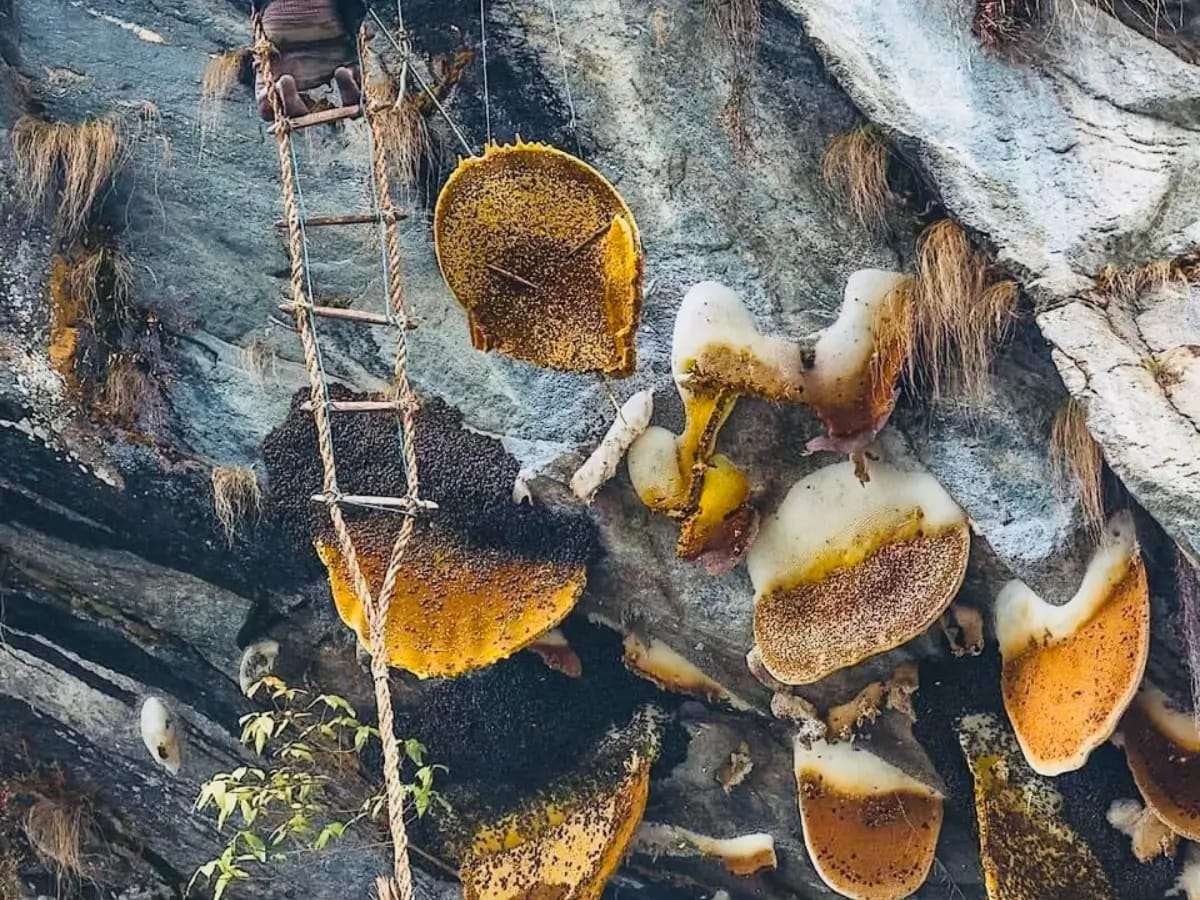
Honey hunting is an age-old traditional practice in Nepal, carried out by indigenous communities, especially by the Gurung and Magar people of the Himalayan foothills. This unique activity involves the harvesting of wild honey from giant honeycombs that hang on steep and vertical cliff faces. The honey is produced by Apis laboriosa, the world's largest honeybee that dwells in high-altitude regions of Nepal between 2,500 and 4,000 meters above sea level. Experienced honey hunters use bamboo ladders, ropes, and tools to descend the cliffs in a communal effort. This is a very brave, skillful, and historically traditional act that requires a tremendous amount of knowledge and practice. While lowering themselves towards the honey, the hunters are surrounded by bees in their thousands, making the venture not only physically challenging but also psychologically taxing. To ensure their safety and soothe the bees, the hunters light some forest herbs and leaves, which, when smoked, enable them to reach the honeycomb comfortably and in the knowledge that the bees will not be harmed in the process. The honeycomb is cut from the rock face and then taken in baskets below. This practice of honey hunting in Nepal, though an adventure, is a cultural expression of harmony in nature.
Cultural and Spiritual Importance of Honey Hunting in Nepal
Beeswax hunting, in the context of Nepal, is not only a risk-prone adventure but also a revered practice in the cultural and spiritual context of the native tribes, specifically the Gurungs and the Magars. The beeswax hunting begins after the villagers have conducted a series of rituals, praying to the gods of the forest and the cliff gods, in a bid to ensure the safety of the beeswax hunters and the success of their hunt. The practice of beeswax hunting in the native context not only holds significant spiritual value, but it is also a communal practice. The locals come together in a celebration of the community, in support of the beeswax hunters, and in the distribution of the newly obtained beeswax from the hunt. The whole process of honey hunting encompasses a symbiotic relationship between humans and the natural environment, bringing together ideals such as valor, belief, and collaboration. This is a model of a traditional practice that links people with nature while preserving their cultures in a rapidly modernizing world. This combination of spiritual reverence and social cohesion makes honey hunting a truly unique cultural phenomenon in Nepal.
Types of Honey Found in Nepal
The country has a variety of wild bees and unique honey varieties, obtained through traditional bee hunting in the Himalayan regions of the country. The two most popular varieties of honey in the country are Wild Honey and Mad Honey.
- Wild Honey: It is sweet, fragrant, and nutritious. It has been used not just as a source of sweetening, but also has a medicinal component that fights ailments such as weakened immunity, digestion, and a lack of energy. This is because it comes from various flowers of the Himalayan ranges, therefore, being organic.
- Red Honey, It is also known as Mad Honey, is extracted from the flowers of rhododendrons grown in mountainous areas. Red honey is distinguished by its strong and unique taste. Its chemical components are natural products that act as psychoactive drugs. Red honey has traditionally been used in very small quantities for medical practices like controlling blood pressure, boosting digestion, and increasing energy.
How Is Honey Made? Natural Honey Production Process
Honey is a natural sweet substance produced by bees through a complex, multi-step process starting with flower nectar. Bees gather nectar from flowers in bloom through their long tongues and transport it to the honey stomach, a special organ. During the journey back to the hive, the natural enzymes present in the body of the bee start breaking down the complex sugars in the nectar into simpler sugars. It is then received inside the hive by worker bees, who further process and deposit it into honeycombs. The bees then use their wings to fan over honeycombs to evaporate water content in the nectar, thus turning it into thick, stable honey. This is because of the proper combination of enzymatic activities and evaporation that yields pure and golden honey. This is especially true in Nepal, where most of the traditional honey hunting takes place; bees collect nectar from a variety of wild Himalayan flowers, including rhododendron, which gives rise to the famous red (mad) honey. Both of these types of honey are highly valued for their unique taste, nutritional benefits, and medicinal properties, thereby being a prized product of the Himalayan ecosystem.
Best Places for Honey Hunting Tour in Nepal
Nepal offers several remarkable regions for experiencing traditional honey hunting, each with its own unique landscapes, culture, and accessibility.
- Lamjung District: This is one of the leading tourist spots for honey hunting. Villages like Ghalegaun, Bhujung, and Ghanpokhara are famous for their traditional honey-hunting practices. One can witness the expert honey hunters practicing their craft amidst the breathtaking background of the Annapurna and Manaslu Ranges. All these villages are not only rich in their cultural heritage but are also suitable for treks and homestays.
- Kaski District: This region is accessible from Pokhara. It is preferred for the honey hunting tour in Nepal. This region is where honey hunting, adventure, and scenic views of hills, forests, and the Annapurna Mountains converge.
- Gorkha & Dhading: These places are less commercialized, with more traditional methods of honey hunting. They are best suited for travelers who long for a genuine cultural experience, far from the usual tourist routes. One can have exposure to actual village life, with interaction with the natives, besides witnessing a genuine honey hunting process.
Best Time for Honey Hunting Tour in Nepal
The best time to experience honey hunting in Nepal is during spring (March–May) and autumn (October–November), when the conditions are ideal for both bees and travelers.
- Spring: This is the prime season for honey hunting. Rhododendron and other wild Himalayan flowers are in full bloom, producing nectar-rich honey, including the famous red (mad) honey. The weather is generally clear and moderate, offering excellent trekking conditions and safe observation of honey hunting rituals. Spring also allows travelers to enjoy vibrant greenery, blossoming forests, and spectacular views of the Annapurna and Manaslu ranges.
- Autumn: After the monsoon, autumn provides clear skies, cooler temperatures, and stable weather, making it perfect for trekking and cultural exploration. Bees remain active, and honey harvesting continues. The landscapes are lush, with fresh rivers, terraced fields, and panoramic mountain views. Visitors can experience authentic village life while safely witnessing honey hunting ceremonies.
Difficulty Level and Fitness Requirement for Honey Hunting Tour in Nepal
Bee hunting in Nepal is an adventure and can be managed with a moderate level of fitness. The path leading to the bee hunting destinations involves hilly and mountain ranges that go through forests and small Himalayan villages. Although the destinations pose a moderate level of difficulty and the terrain involves somewhat steep ascents or descents at times, the journey can be completed without the need for any advanced mountain-climbing skills since the dangerous cliff bee harvesting is done by professional local bee hunters. One needs to be able to hike for 3 to 6 hours a day, with trails sometimes being rough and sometimes muddy, depending on the time of year. Wearing treks, keeping a light pack, and being well-hydrated are imperatives for making this a pleasant experience. This level of physical fitness will enable one to participate in the exciting experience that is honey hunting, appreciate the culture, and take in the majesty of the Himalayas.
Safety and Responsible Travel for Honey Hunting Tour in Nepal
Honey production in Nepal is always a thrilling part of Nepalese culture, but it does come with some danger associated with the vertically high cliffs and bee colonies. It is therefore important to note that tourists should never consider scaling the cliffs to produce honey but should rely entirely on the expertise of local honey hunters. This helps in maintaining a safe distance while at the same time not interfering with the natural habitat of the bees. A responsible travel agent is also a key consideration. Arrivals should be encouraged to adapt to local cultures and traditions, to observe local rituals and respect local environments, not to disrupt local wildlife habitats, or to create litter or use too much plastic in local villages. Hiring a professional licensed agent or tour operator can definitely enhance the experience and make it safe and enjoyable. Their guides and permits ensure that the visitors are safe while witnessing the honey hunting ceremony. If the visitors behave responsibly and follow proper guidance, then honey hunting in Nepal can be a safe and enjoyable experience.
Why Choose a Nepal Honey Hunting Tour?
One of the very few places around the globe where one can experience the original form of bee hunting is Nepal. With breathtaking views of the Himalayas, its rich culture, and its unique wildlife, it is indeed the best place to experience this exciting activity. This age-old bee hunting routine has been passed down from generations by tribes like the Gurung and Magar, which allows one to see something that nowhere else in the world does. Nepal honey hunting tour also gives one a chance to venture into some of the distant rural village areas, trekking trails, and into the Himalayan ranges like Annapurna and Manaslu. One gets to experience adventure as well as immersions in the cultures while relishing some of the Himalayan honey and red/mad honey. With professional guides, visitors can appreciate the hazardous process of harvesting on the cliffs while participating in community-based tourism, ensuring that the practice is carried out sustainably. This honey harvesting experience in Nepal is a perfect blend of culture, adventure, and nature, ensuring that one gets a truly unique Himalayan experience.
Medicinal Uses of Honey: Hunting Honey in Nepal
The honey that is harvested from the traditional honey hunting methods found in Nepal is very important and treasured not only because of its flavor but also due to its medicinal values. Two forms of honey are harvested. The two are Red Mad Honey and Wild Himalayan Honey.
- Red Honey (Mad Honey): It is produced by rhododendrons, whose nectar is fed on by bees. It has natural properties named grayanotoxins. It has medicinal uses when used in small quantities. It is used for controlling high blood pressure, for treating cardiac ailments, for improving & weighting digestive problems, for relieving body and joint pain, for reducing stress and conditions of fatigue, for treating sleep ailments, and for treating asthma and respiratory problems. However, excess use may cause dizziness, nausea, hypotension, or weakness. It is imperative to seek expert advice before consuming mad honey.
- Wild Himalayan Honey: The Wild Himalayan Honey is obtained from a wide variety of flowers. It has a high concentration of enzymes and antioxidants. Its medical properties include enhancing immunity, treating cold, cough, and sore throat, managing digestion, increasing natural energy levels, healing wounds, and serving as a natural antibiotic.
Honey of both kinds is a natural remedy that the people of the Himalayas have long utilized as a way, making the Nepal honey hunting tour trip not only into cultures, but also into Himalayan remedies as well.
Traditional Honey Hunting Belief and Local Use
In Nepal, honey is considered highly precious from the medicinal, nutritional, and social significance perspectives. The local inhabitants, especially the Gurung and Magar tribes, have been using "Mad Honey" with a limited quantity for the treatment of high blood pressure, intestinal diseases, joint pain, weakness, and ailments related to the respiratory system, among others, as "Mad Honey" contains an element with a mild psychoactive action, which acts as a sleeping aid and helps relieve stress and tension.
Wild Himalayan Honey, gathered from various flowers of the forests and mountain ranges, is employed for immunity enhancement, treating common cold, throat pain, minor wound healing, and natural energizing. It is termed a natural antibiotic for its energizing property.
Aside from its health properties, honey has significant cultural value. It has been a part of rituals, festivals, and communal events, portraying an aspect of prosperity, appreciation for nature, and knowledge from ancestors. The adventure of taking a Nepal honey hunting tour would enable a person to appreciate these elements of the Himalayan culture.
Trek Experience, Outline, and Itinerary of the Honey Hunting Tour
This Nepal Honey Hunting Tour is one such unique adventure that combines cultural immersion, moderate trekking, and the thrill of witnessing traditional honey harvesting. Trekkers will journey through forests, terraced farmland, rivers, and remote Himalayan villages to experience an authentic lifestyle with the Gurung and Magar communities. The trek also affords breathtaking views of the Annapurna and Manaslu ranges while introducing travelers to the local flora, fauna, and Himalayan culture.
Honey hunting tour in Nepal involves cliff visits with the help of experienced local hunters, who give information regarding the preparation of wild Himalayan bees producing red honey (mad) and wild honey. As there are trekking portions, most of the trekking routes are generally moderate, but they also contain forest trails, uneven terrain, and small hill ascents that require basic to moderate fitness levels. The tour offers possibilities of cultural exchange, village walks, and tasting newly harvested honey, making it adventurous yet educational.
Nepal Honey Hunting Tour Itinerary
DAY 1: Arrival in Kathmandu
DAY 2: Drive from Kathmandu to Besisahar to Bhujung Village
DAY 3: Traditional Honey Hunting Experience
DAY 4: Bhujung Village Sightseeing & Cultural Experience
DAY 5: Drive from Bhujung Village to Besisahar to Kathmandu
DAY 6: Departure
Nepal Honey Hunting Tour Cost
The cost of the tour includes transportation, local guides, accommodation, meals, permits, and honey hunting arrangements. On average, a 6-day Nepal Honey Hunting Tour costs approximately $800–$1000 per person, depending on the season, group size, and accommodation style. Traveling with a licensed operator like Well Nepal Travel and Treks ensures all arrangements are taken care of for a safe, smooth, and culturally immersive experience.
Why Choose Us for Your Honey Hunting Tour
Having the right travel companions is crucial for a safe and enjoyable honey hunting experience in Nepal. Well, Nepal Travel and Treks, a licensed tour and trekking company established in 2012, is your trusted partner for expert guidance, comfort, and an authentic Himalayan adventure. We provide experienced, licensed local guides who ensure you can safely observe traditional honey hunting while learning about the culture, rituals, and lifestyle of Himalayan villages. All arrangements, including transportation, accommodation in local homestays, and necessary permits, are fully managed by our team. Our tours are carefully designed to offer comfortable trekking routes, cultural immersion, and scenic Himalayan views, with attention to your safety, health, and overall experience. With proper guidance, nutritious meals, and emergency support, our honey hunting tours are suitable for both first-time adventure travelers and experienced cultural explorers. By choosing Well Nepal Travel and Treks, you will enjoy a well-organized, secure, and unforgettable honey hunting adventure, creating lasting memories of Nepal’s unique natural beauty and rich cultural heritage.


